

Blog
What is Slow Jigging and why is it so effective?

Liam Faisey gives us the lowdown on this top boat fishing method that might have taken a while to catch on in the UK but is now being used to devastating effect both at home and abroad….
Slow Jigging, or Slow Pitch Jigging, is a relatively new technique to enter the lure fishing world. It has quickly become the go-to method for many saltwater lure anglers fishing afloat thanks to it’s ability to catch fish when other methods just won’t work. Slow Jigs can now be found in the tackle boxes of lure anglers worldwide.
Originating in Japan, Slow Jigging is method that is a little different to the norm in that you are not necessarily targeting actively feeding fish. Whilst a fish may not be on the hunt for food for a wide range of reasons, an opportunistic meal for little energy expenditure often proves irresistible to many predatory fish. Nothing comes much easier than an injured or distressed baitfish, with limited ability to escape, limping erratically in front of you! A slow jig is designed to mimic this very action and ‘flutter’ in a way to induce a strike from fish that might not otherwise be interested in feeding. Whilst aimed at catching fish that are not in feeding mode, any actively hunting predatory fish or ambush predator will also find the action of a slow jig hard to resist.


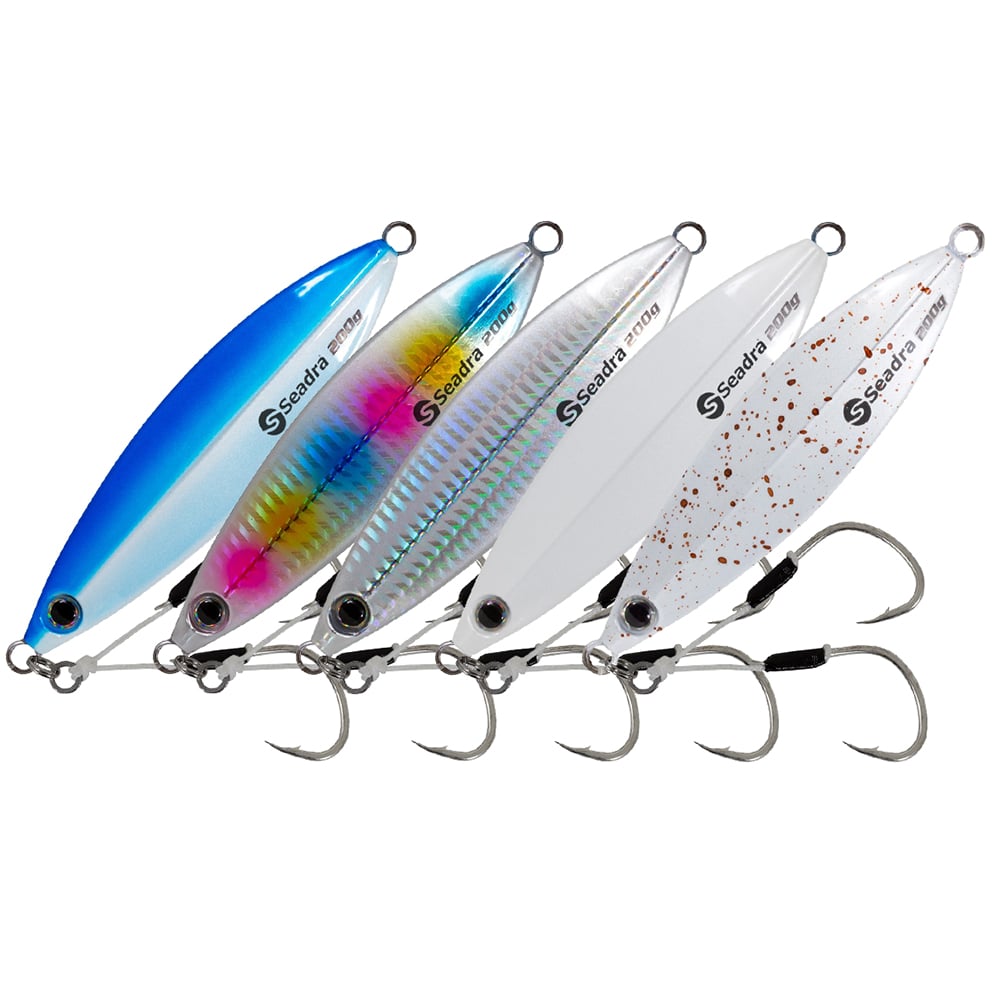
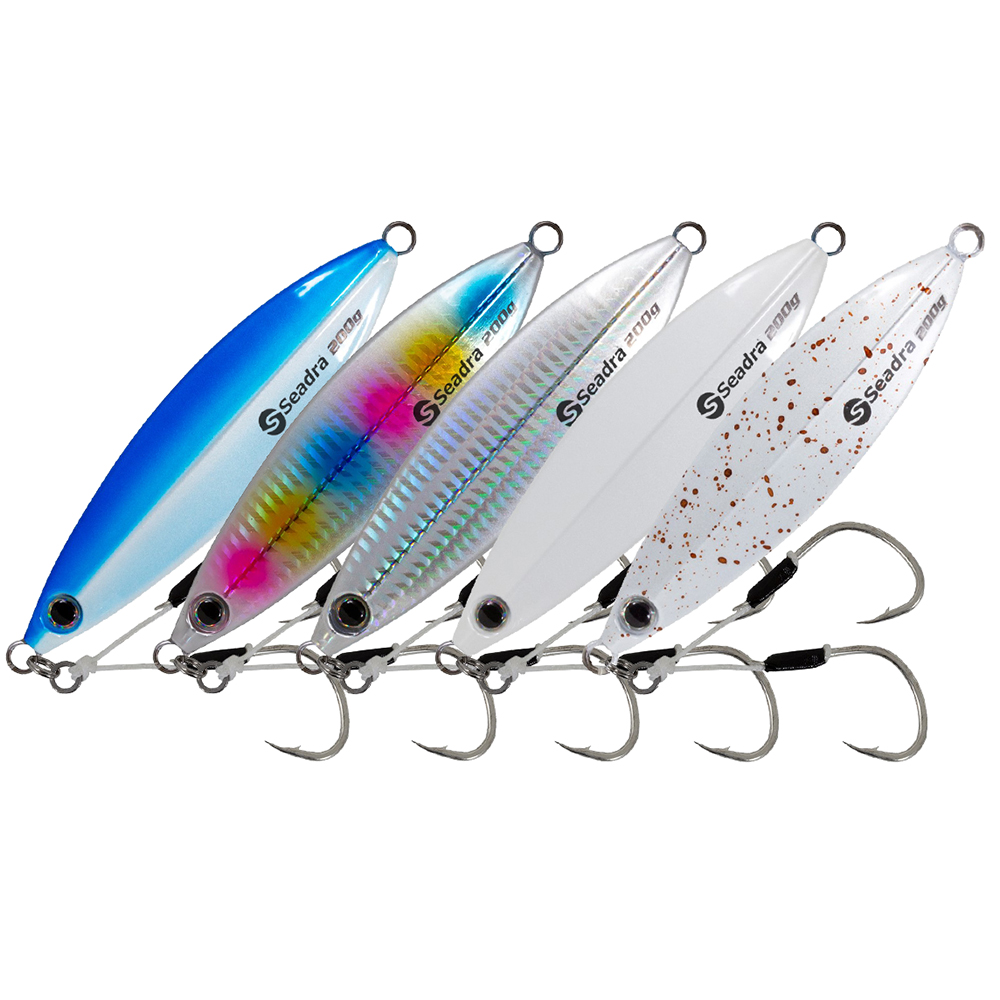
Slow jigs are a type of flattened metal lure that tend to be shaped like a leaf. They are centre weighted on one side and this forces the jig to fall with a fluttering action through the water to maximise “hang-time” in the zone where the fish may be sitting. The erratic motion and vibrations given off by a fluttering jig will tap into the most primal of predatory instincts to induce a strike. The jig is worked by first drawing it up through the water, known as pitching the jig. This is usually done by raising the rod and loading the blank, then allowing the blank to unload with the recovering rod tip causing the jig to spring up through the water. Some purists will do this with sharp turns of the reel handle alone. You then allow the lure to flutter back down on a slack line as you lower the rod tip to repeat the process. The jig can either be fished at the same depth or with a slow retrieve by gaining a half wind or full wind of the reel handle with each lift of the lure. There are lots of variations that can be put into play here with the length of the lift, speed of the lift, retrieve rate, but the basics remain the same for the motion of the jig – lift up, flutter down. A whole array of slow jigs are now available with different weights, colours and fall patterns to suit different situations and species.


Using braid is essential for keeping in contact with the jig at all times, especially so in deep water. Hits usually come as the jig is falling or during the short pause before the lift. It is quite exciting to go from a jig falling freely to full bend into a fish in one swift motion as you go to lift the jig again! Braid gives you that instant indication as soon as something intercepts the jig allowing you to set the hooks quickly. Rigged with high quality twin assist hooks mounted at the top of the jig, you can almost be certain of a hook up if a fish strikes.

Slow Jigs tend to be best worked close to the bottom, particularly around reefs and rough ground, where fish may be resting or taking refuge whilst not actively feeding. They will work in midwater too for some shoaling species. It is best to fish with a short mono leader to combat any rocks and structure that the jig or hooked fish may come across. With the need to keep above the jig to impart the optimum action, slow jigging is best done from a boat or kayak, although smaller slow jigs can be effectively fished from the shore on some marks. The hour or two either side of slack water proves particularly good as you can really keep in connection with the jig and work it at its best. Too much tide, or wind against tide scenarios can quickly lead to the jig fishing further away from the craft and at an angle not conducive to imparting the full flutter action on the jig.


Specialist slow jigging tackle is available but don’t get too hung up on this as a slow jig can be fished just as well on a general lure fishing set up. Slow jig rods tend to be around 6ft in length with a slow taper parabolic action that will bend through the butt with a fish on. These are usually paired up with a small narrow-spooled multiplier reel with large handle to make retrieve in deep water easier, and strong yet silky smooth drag to play large fish on these light rods. With a slow jigging rod, the blank is mainly designed to work the lure with the reel designed to play the fish. Heavy pumping or high sticking on a strong fish can risk a blank failure so it is important to let the reel do the work of playing and tiring the fish. A proper slow pitch set up can be worked all day long without fatigue and perhaps if you do want to slow jig all day then this type of set up will be worth investing into. For the occasional slow jig work, most general lure rods for soft plastics / hard plastics will be just fine, you will just have to adapt the lift / fall technique to suit and get the best action from the jig with the rod in hand. I am often fishing slow jigs on a 7ft 8in fast action lure rod rated to 60g paired with a small fixed spool loaded with braid. This proves to be versatile for fishing soft plastics, hard lures and metals such as slow jigs given me plenty of options during a sessions.

Slow jigging proves particularly effective for many UK species. Our cold waters often see fish sit on or near the bottom in a state of lethargy before it is worth them expending energy and going on the hunt for food. Feeding times are often in tune with specific states of the tide or times of the day, and there can be many hours between times of active feeding. Fishing a slow jig during these times will often see you catching more fish than you usually would with other methods. This is a deadly technique for many species including Bass, Pollack, Cod, Coalfish, Wrasse, Gurnards and Ling. Over the past few years I have caught some rarities on a slow jig including John Dory and even a Megrim Sole so you just never know what you may catch when fishing a slow jig. Wrecks, reefs, deep rough ground and more are all worth a try with a slow jig, particularly if other methods are proving to be ineffective. Add a selection of slow jigs to your box of lures and give them a try!