



Blog
Fishing for blonde rays

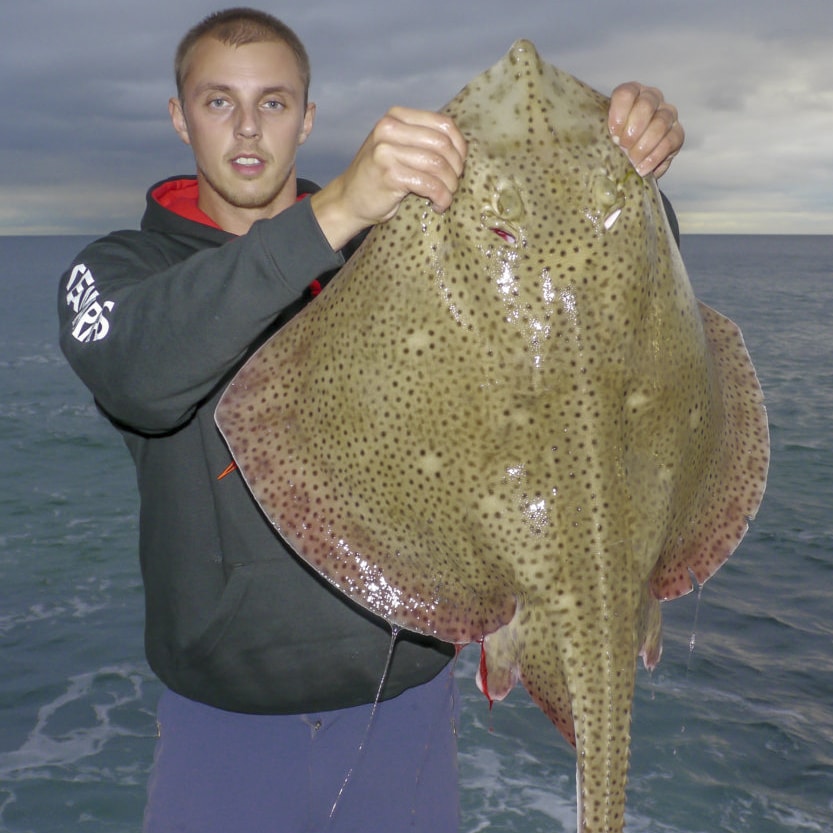
Carl McCormack takes the reigns on today’s blog. Carl has landed a huge number of specimen blonde rays from the south Devon coastline, so who better to give us his thoughts on fishing for them…
Along the southwest coast of the UK, the blonde ray is the largest species of ray you are likely to encounter and as such attracts much attention from both local angler’s and those willing to travel. During the autumn, the larger female blonde ray moves inshore to drop its purses and this is the prime time to target a fish of specimen weight. It goes without saying that these fish should always be handled and treated with the upmost respect.
Location and times
The majority of the productive marks in south Devon seem to be fairly shallow but can have a lot of tide. Without doubt, the blondes seem to be attracted to an area subject to extreme tidal movement. Another feature the blondes seem to love is an area of clean sand that is very close to the rough ground. I would think the reason for this is because it’s more than likely where they lay their eggs. As previously mentioned, the prime time for the larger fish is in the autumn, but blonde rays can be caught throughout the summer months too. The fish definitely move closer to the shore during the evening and in the dark, but occasionally can be found inshore if the sea is coloured up after a good stir.

A stunning blonde for Carl McCormack
Tackling up
Any sea fishing beach caster that is capable of casting a 6oz lead should be ample, although if you have a fair bit of rough ground to winch your catch in over you may want to consider something with some extra power. Blonde rays love to hug the bottom, sometimes to the extent that you’ll actually think your snagged up. If this happens, don’t pull too hard- they’ll usually swim off again after a short time. Reel wise, we use Penn 525 mags loaded with 20lb Varivas Yellow Sport line. This high visibility mono has the added bonus of being great for spotting bites in the dark.

Penn 525 Mag3 – Carl’s choice of reel
Rigs
The good old pulley rig is as effective as anything, although we do also use a pulley dropper to keep the bait hard on the bottom. Whichever rig you opt for it always pays to have a long trace of at least 2ft+ to keep the ray away from the lead. We construct our rigs out of 100lb Varivas Heavy Rig Nylon, both for the body and the hook length. There is a very realistic chance of a 20lb plus fish but when they have been landed to over 30lb, there really is no reason not to ensure that your entire set up is as robust as possible. Varivas Big Mouth Xtra hooks of around a size 5/0 are fished as a pair (penell rig) but always match your hook size to your choice and size of bait (see below).
Bait
If we could only use one bait to target the blondes, it would without a doubt be sandeel. The blonde ray is not a fussy eater, most fish baits will work including squid, mackerel or bluey or even a cocktail, but sandeel’s really are so consistent. Lots of anglers like to wrap a piece of squid around their sandeel and this can be a deadly tactic, especially when the fishing is slow, but it can also draw in the dreaded dogfish before a ray gets a look in.

A tasty looking sandeel and squid cocktail
The bite
The moment we all wait for! Fishing for the blondes on our coastline is all about the hours you put in and sometimes we could fish as many as ten sessions before we even get a bite from a blonde. It’s important not to be to keen to strike so be patient and let the bite develop. Always fish with the reels clutch slackened off and the ratchet on.
With a little luck, after the initial knocks the rod tip will gradually pull over as the ray moves off with the bait, or the line will fall slack as it dislodges the lead and moves towards you. It’s best to wait for either of these two things to happen before making your move- missed bites are often a result of over excitement and after waiting for many hours for this fish, it’s important to pick your moment. With your clutch set slightly to counteract the initial run, take up the slack, if there is any and lift the rod with a positive action. Fingers crossed, it will be “fish on!”

The result of patience when a ray takes the bait
Unhooking and handling
Fishing from a sandy beach makes landing a ray relatively easy and safe. Use the surf to coax her on to dry land. If the fish is particularly large and the water in front of you is especially shallow, chest waders may be useful. Landing fish from the rocks requires a calm head and good footing. Safety should always take priority over your catch. Fishing alone from the rocks is never a good idea and landing a big fish alone can be tricky, even in favourable conditions.
A long handled net should be used unless it is absolutely safe to bring the fish to within arms length, in which case it can be simply lifted from the water just back from the leading edge of the wing. Use caution when unhooking a blonde ray as it’s powerful jaws can cause damage to unprotected fingers. A T-bar is a very useful tool for this. All of our rays are returned as quickly as possible after a couple of photo’s and a quick meeting with the scales.

Unhooking – fingers or T-Bar? Tough choice
Related Posts
The Ultimate Guide to Penn Tidal Beach Fishing Rods

Century Eliminator X Series- Fantastic First impressions!

Smoothhound Fishing Aboard the Aly Kat – Veals Mail Order Hits the Bristol Channel
The Ultimate Guide To Beach Shelters
squid fishing UK- A Beginners guide
It’s Blonde Ray Fishing Time!
Easy Bristol Channel fishing spot!
Chesil In The summer- Small Baits Rule!
Fenix HP35R- A New Contender For Best Headlamp?
Wrasse Fishing- Simple And Fun!
FISHING IN The New Clear Bristol Channel
The Dongle- Where are we at?
One thought on “Fishing for blonde rays”
Comments are closed.

Great pics guys and some nice rays, with very useful advice. Caught them from a boat over Portlands Kidney Bank. Now you have wetted my appetite for a shore caught kite.